Lunar New Year Feast in Vancouver: Where to Celebrate...
Explore Lunar New Year food traditions in Vancouver — from Chinese reunion dinners and Vietnamese Tet feasts to Korean Seollal dishes. Where to eat, shop, and celebrate across Metro Vancouver.
Every late January or early February, Vancouver transforms into one of the best cities outside Asia to experience Lunar New Year through food. The holiday — observed by Chinese, Vietnamese, Korean, and other East and Southeast Asian communities — isn't a single meal. It's a weeks-long procession of symbolic dishes, family gatherings, market runs, and restaurant feasts that reflects the extraordinary cultural depth of Metro Vancouver's Asian population. With over 500,000 residents of Chinese heritage alone, plus significant Vietnamese and Korean communities, the food traditions here aren't diluted tourist-friendly approximations[1]. They're the real thing, practiced with the same seriousness and detail you'd find in Hong Kong, Saigon, or Seoul.
What makes Vancouver's Lunar New Year food scene distinctive is the convergence. Within a 30-minute drive, you can eat a Cantonese reunion dinner in Richmond, pick up banh tet from a Vietnamese bakery on Victoria Drive, and buy tteok (rice cakes) for Korean tteokguk at an H-Mart in Coquitlam. That kind of cross-cultural Lunar New Year access doesn't exist in many places, and it's something worth understanding deeply — not just as a dining guide, but as a window into how food carries meaning across three distinct cultural traditions sharing the same calendar marker.
This guide covers the food traditions, the restaurants, the grocery sources, and the practical logistics of celebrating Lunar New Year in Vancouver — whether you're hosting a reunion dinner at home, booking a restaurant for a multi-course feast, or simply trying to understand why your Vietnamese colleague brought a box of mut to the office.
Summary: Vancouver's Lunar New Year food scene ranks among the strongest outside Asia, drawing on the city's 500,000+ Chinese residents alongside significant Vietnamese and Korean communities. Within a 30-minute drive, you can experience Cantonese reunion dinners in Richmond, Vietnamese Tet feasts on Victoria Drive, and Korean Seollal dishes in Coquitlam. This guide covers food traditions, restaurant options, ingredient sourcing, and celebration logistics across Metro Vancouver.
Last reviewed: March 2026. Data current as of this date.
The Symbolic Language of Lunar New Year Food
Lunar New Year food is never just food. Every dish on the table carries meaning, and families choose what to serve based on wordplay, appearance, and centuries of cultural logic. Understanding the symbolism transforms a meal from a collection of dishes into a coherent statement about what a family hopes for in the coming year.
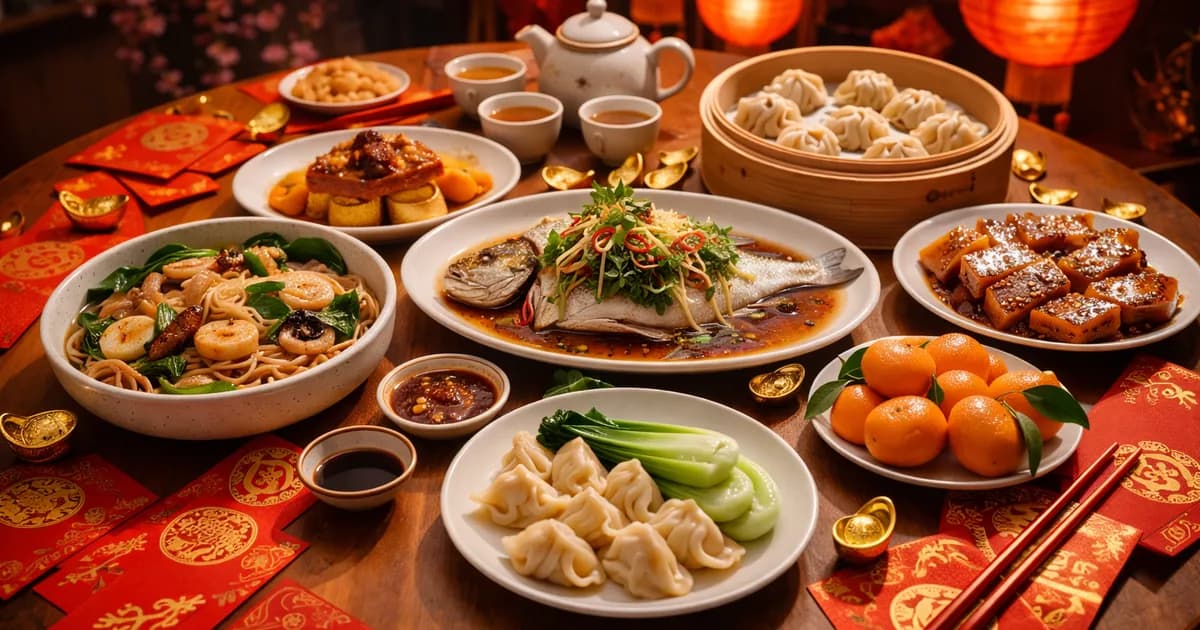
The Chinese tradition is the most elaborate in its food symbolism, driven largely by homophones in Mandarin and Cantonese. The word for fish (yu, 鱼) sounds identical to the word for surplus or abundance (yu, 余), which is why a whole steamed fish appears on virtually every Chinese New Year table — and why it's traditionally left partially uneaten, to symbolize surplus carrying into the next year[2]. Noodles are served uncut because their length represents longevity. Dumplings, shaped to resemble ancient gold ingots, signify wealth and prosperity. Tangyuan (glutinous rice balls) represent family togetherness through their round shape, since the word for round (yuan, 圆) sounds like the word for reunion (tuanyuan, 团圆)[3].
Vietnamese Tet food carries its own symbolic vocabulary. Banh tet (cylindrical sticky rice cakes) and banh chung (square sticky rice cakes) represent the earth and the cycle of seasons. Mut — a colourful assortment of candied fruits and seeds — symbolizes a sweet year ahead, and each variety carries specific meaning: coconut strips for togetherness, lotus seeds for fertility, ginger for warmth and health[4]. Korean Seollal centres on tteokguk, a soup of sliced rice cakes in clear broth. Eating tteokguk on New Year's Day symbolically adds one year to your age, and the white colour of the rice cakes represents purity and a fresh start[5].
What's remarkable in Vancouver is how these three symbolic vocabularies coexist and sometimes overlap. Families with mixed Chinese-Vietnamese heritage — of which there are many in Metro Vancouver — might serve both jiaozi and banh tet at the same table, layering meanings from two traditions into a single meal. The food becomes a conversation between cultures, mediated by a shared calendar date.
The Chinese Reunion Dinner: Heart of Spring Festival
The reunion dinner (nian ye fan, 年夜饭) on New Year's Eve is the most important meal of the Chinese calendar year. It's the reason flights to China sell out weeks in advance and the reason Vancouver's Chinese restaurants operate at peak capacity for days surrounding the holiday. For families who cannot travel back to Asia, the reunion dinner in Vancouver is the anchor — the non-negotiable meal that everyone attends.
A traditional reunion dinner in a Cantonese household — and Cantonese families represent the largest Chinese demographic in Vancouver — follows a loose but recognizable pattern[2]:
- Whole steamed fish — always served last or near the end, always left partially uneaten to carry abundance into the new year
- Roast meats — barbecue pork (char siu), roast duck, or roast suckling pig, representing wholeness and prosperity
- Chicken — often a whole poached chicken, symbolizing family unity and good fortune
- Longevity noodles — served uncut, the longer the better
- Nian gao — sticky rice cake, because the word gao sounds like "high," representing advancement
- Jiaozi (dumplings) — especially for families with Northern Chinese roots, folded to resemble gold ingots
- Vegetables — lettuce (sheng cai, 生菜, sounds like "generating wealth"), fat choy (a black moss whose name sounds like "getting rich")
- Tangyuan — sweet glutinous rice balls for the Lantern Festival that closes out the celebration period
The precision of this tradition matters. The fish must be whole — a fillet won't do, because it needs a head and a tail to represent a complete year. The noodles must not be cut, because cutting them would be cutting your lifespan short. These aren't superstitions that families laugh off. In many Vancouver households, particularly among first-generation immigrants and their parents, they're observed with genuine seriousness.
Where to Eat Reunion Dinner in Vancouver
For families who prefer to celebrate at a restaurant rather than cooking at home — or who simply need a larger venue than their apartment allows — Vancouver and Richmond offer strong options. The reunion dinner restaurant scene operates on a different set of rules than normal restaurant dining, and understanding those rules matters if you want a good experience.
Richmond is the epicentre. The stretch along No. 3 Road from Lansdowne to Steveston, and the cluster of restaurants near Alexandra Road, hosts the densest concentration of Chinese restaurants offering formal Lunar New Year set menus. These set menus are specifically designed for the reunion dinner: 8 to 12 courses, family-style, built around the symbolic dishes described above.
Set menu pricing typically ranges from $40 to $80 per person for standard options at established Chinese seafood restaurants in Richmond. Premium restaurants with live seafood — where you select your own fish from the tank — push toward $80-$120 per person. These prices rise slightly during the peak Lunar New Year period, which is standard and expected. A table of 10 at a mid-range Richmond seafood restaurant for reunion dinner will generally run $500-$700 before drinks and gratuity.
Restaurants to consider for reunion dinner:
- Seafood banquet halls in Richmond — Establishments along No. 3 Road and Alexandra Road are the traditional choice for large family reunions. Look for restaurants advertising specific Lunar New Year set menus (tuan nian fan, 团年饭) starting in late December. These menus include the required symbolic dishes — whole fish, chicken, nian gao — built into the course sequence.
- Cantonese dim sum restaurants — Some families, particularly those with elderly members who prefer daytime dining, hold their reunion gathering as a lavish dim sum lunch on New Year's Eve or New Year's Day. This is increasingly common in Vancouver's Chinese community.
- Modern Chinese restaurants — A newer category of restaurants in both Richmond and Vancouver proper offers contemporary takes on reunion dinner, with updated plating and fusion elements while maintaining the core symbolic dishes. These tend to attract younger families and mixed-heritage groups.
Booking is critical. Reunion dinner tables at popular Chinese restaurants in Richmond sell out two to four weeks before New Year's Eve. Some restaurants begin taking Lunar New Year reservations in early December. If you're planning to dine out for the reunion dinner, call by early January at the latest. Walk-ins on New Year's Eve are essentially impossible at any reputable Chinese restaurant in Metro Vancouver. This is the single busiest dining night of the year for Chinese restaurants — more so than Western New Year's Eve or Valentine's Day.
Vietnamese Tet in Vancouver: A Feast of Preparation
Vietnamese New Year (Tet Nguyen Dan, usually shortened to Tet) shares the same lunisolar calendar as Chinese New Year but carries a distinctly different food culture. Where Chinese reunion dinner is a single climactic meal, Tet food is about days of preparation and a table that stays stocked throughout the holiday period. Walking into a Vietnamese home during Tet, you'll find a spread that has been assembled over the preceding week — the banh tet has been cooking since before dawn, the mut was arranged in decorative boxes days ago, and the refrigerator is stacked with pre-made dishes meant to sustain the family through three days of visiting and receiving guests[4].
Key Tet foods available in Vancouver:
- Banh tet — cylindrical sticky rice cakes filled with mung bean paste and pork belly, wrapped in banana leaves and boiled for hours. The southern Vietnamese version, dominant in Vancouver's community. Available at Vietnamese bakeries and delis along Kingsway and Victoria Drive during the Tet season.
- Banh chung — the square version, more associated with northern Vietnam. Less common in Vancouver but available at select bakeries.
- Thit kho trung — caramelized pork belly braised with hard-boiled eggs in coconut water. A foundational Tet dish that represents completeness. The eggs must be whole, the pork must include both lean and fatty layers.
- Gio lua / Gio thu — Vietnamese pork roll (cha lua) and head cheese, made from ground pork wrapped in banana leaves and steamed or boiled. A staple on every Tet table.
- Mut — a tray of candied and preserved fruits, seeds, and vegetables. Coconut strips, ginger slices, lotus seeds, kumquats, and tamarind. Each piece carries symbolic meaning and is offered to guests with tea.
- Dua hanh — pickled onion or leek, served alongside rich dishes as a digestive and flavour counterbalance. The sourness cuts through the heaviness of braised pork and sticky rice.
- Cu kieu — pickled small shallots, another essential accompaniment.
Where to find Tet food in Vancouver:
The Victoria Drive corridor between 33rd Avenue and 49th Avenue is the historical centre of Vancouver's Vietnamese food community. During the two weeks before Tet, Vietnamese bakeries and delis here stock banh tet, gio lua, mut, and other seasonal specialties that are difficult to find the rest of the year. Kingsway between Fraser and Nanaimo also has Vietnamese establishments carrying Tet staples. Some Vietnamese restaurants offer special Tet set menus, though this is less formalized than the Chinese reunion dinner tradition — Tet dining tends to happen at home rather than at restaurants.
For grocery sourcing, T&T Supermarket carries a wide Tet selection including pre-made banh tet, packaged mut, and the banana leaves and glutinous rice needed for making banh tet from scratch. The smaller Vietnamese-specific grocery stores on Victoria Drive carry more specialized items — fermented fish sauce (mam ca), specific varieties of dried shrimp for banh cuon, and the exact brand of coconut milk that your grandmother insists upon.
Korean Seollal in Vancouver:
Tteokguk and Ancestral Rites
Korean New Year (Seollal, 설날) follows the same lunar calendar but has the most ritualistic food tradition of the three cultures. The centrepiece is tteokguk — a clear broth soup with sliced rice cakes (tteok), egg, dried seaweed, and often beef. Eating tteokguk on New Year's morning is not optional in any traditional sense. It's how you officially become one year older. Children who refuse their tteokguk are told they won't age — which at six years old sounds like a win, but the cultural expectation is clear[5].
Key Seollal foods:
- Tteokguk — the essential dish. Sliced oval rice cakes in beef or anchovy broth with egg ribbons, seaweed, and scallions. The white rice cakes represent purity and the beginning of a new year.
- Jeon — pan-fried savoury pancakes of various types: dongtae jeon (pollack), hobak jeon (zucchini), yukjeon (beef). Prepared in advance and served throughout the holiday. Part of the ancestral rite (charye) food offering.
- Japchae — stir-fried glass noodles with vegetables and beef. The noodles represent longevity, and the dish is a fixture at every Korean celebration meal.
- Galbi-jjim — soy-braised beef short ribs, slow-cooked until the meat falls from the bone. A high-effort, high-reward dish reserved for special occasions.
- Mandu — Korean dumplings, often added to tteokguk in northern Korean tradition (making it tteok-mandu-guk). Shaped like half-moons for fortune.
- Sikhye — sweet fermented rice drink served cold as a digestive and palate cleanser after the heavy meal.
The charye (ancestral rite): Before the meal, many Korean families set a formal table of food offerings for deceased ancestors. The arrangement is specific — fish facing east, fruit in a set colour order, rice cakes at the centre. After the rite, the family eats the same food. In Vancouver's Korean community, the practice varies by generation. Older families maintain the full ritual; younger families may simplify it or acknowledge it symbolically. Either way, the food is the same.
Where to experience Seollal food in Vancouver:
Vancouver's Korean food presence is centred in two areas. The Lougheed Highway and North Road corridor near Coquitlam Centre has the highest density of Korean restaurants in Metro Vancouver. Downtown, the Robson-Denman stretch has Korean restaurants that cater to a more mixed clientele. During Seollal, some Korean restaurants offer holiday specials, though like Tet, Seollal is primarily celebrated at home.
H-Mart (locations in Coquitlam and Vancouver) is the primary Korean grocery source for Seollal ingredients. They stock fresh tteok (rice cakes) year-round, but during the Seollal period the selection expands to include pre-sliced tteokguk tteok, prepared japchae ingredients, and the specific varieties of dried anchovy and kelp needed for proper tteokguk broth. Korean bakeries in the Lougheed corridor also stock Seollal-specific items like songpyeon (pine-scented rice cakes, more associated with Chuseok but sometimes prepared for Seollal as well) and yakgwa (honey cookies).
Where to Buy Ingredients for Home Celebrations
For many Vancouver families, the Lunar New Year feast is cooked at home — and the grocery run is its own cultural event. The week before Lunar New Year, the Asian grocery stores across Metro Vancouver shift into a different mode. Displays change. Seasonal products that are invisible the rest of the year appear on endcaps and dedicated tables. The checkout lines at T&T on a Saturday before New Year can stretch halfway through the store.
T&T Supermarket — The anchor for Chinese and pan-Asian Lunar New Year shopping. The Richmond locations (on No. 3 Road and at Aberdeen Centre) carry the most extensive selection: pre-made nian gao in multiple flavours, fresh glutinous rice flour for homemade tangyuan, whole fish suitable for steaming, Chinese sausage (lap cheong) for turnip cake (lo bak go), and the dried goods — mushrooms, dried shrimp, fat choy — that form the backbone of a traditional reunion dinner. They also carry Vietnamese Tet items (banh tet, mut) and Korean tteok. Prices for seasonal items like nian gao and tangyuan are competitive with Chinatown shops, and the convenience of one-stop shopping makes T&T the default for most families.
H-Mart — The primary source for Korean Seollal ingredients. The Coquitlam location on North Road is the most comprehensive. Fresh tteok for tteokguk, Korean-cut beef brisket for broth, dried anchovies (myeolchi) sorted by size, dasima (kelp), and fresh mandu. H-Mart also carries a solid selection of Chinese New Year staples, making it a secondary option for families celebrating both Chinese and Korean traditions.
Superstore / No Frills Asian sections — Several Superstore locations across Metro Vancouver have expanded their Asian food sections significantly. While they won't match T&T or H-Mart for depth, they carry the basics: glutinous rice, nian gao, wonton wrappers, soy sauce, and some seasonal items. Useful if you need a few ingredients alongside your regular grocery run.
Chinatown shops — Vancouver's Chinatown still operates several traditional Chinese grocery stores that carry dried goods, preserved meats, and specialty ingredients at prices that undercut the chain stores. For dried shiitake mushrooms, aged dried tangerine peel (chen pi), and premium dried scallops — the kind of ingredients that define a high-quality reunion dinner broth — Chinatown remains the best source. The trade-off is that these shops tend to be cash-preferred, Chinese-language-only, and cramped. But the quality of their dried goods is often superior to chain stores buying from the same wholesale suppliers at lower volumes.
Vietnamese bakeries on Victoria Drive — For banh tet, gio lua, and other prepared Tet foods, the Vietnamese bakeries between 33rd and 49th on Victoria Drive are unmatched. Some take advance orders for banh tet — recommended, since demand exceeds supply during peak Tet week.
Festival Events and Celebrations
Lunar New Year in Vancouver isn't confined to private dining rooms. The city hosts public celebrations that make the holiday visible and accessible to everyone, and understanding the event calendar helps you plan your food experiences around them.
Vancouver Chinatown New Year Parade — The longest-running Lunar New Year parade in Canada, typically held on the Sunday closest to New Year's Day. The parade route runs through Chinatown on Pender and Keefer Streets. The food angle: Chinatown restaurants fill up before and after the parade, and street food vendors sometimes set up along adjacent blocks. If you want to eat in Chinatown on parade day, arrive early and expect crowds[6].
Richmond Lunar New Year celebrations — Richmond holds celebrations at multiple locations, including Aberdeen Centre and Richmond Centre. These tend to be indoor events with cultural performances, and the adjacent food courts and restaurants in these malls become extremely busy. Aberdeen Centre's food court in particular is standing-room-only during Lunar New Year events. The upside is the concentration: within the mall complex you can eat dim sum, buy nian gao, watch lion dances, and let your kids collect lai see (red envelopes) from performing troupes.
International Buddhist Temple, Richmond — One of Vancouver's most popular Lunar New Year destinations. Thousands visit during the first days of the new year to pray, light incense, and eat vegetarian festival food. The temple grounds are packed, parking is a serious challenge, and the experience is unlike anything else in Metro Vancouver during this period. The food offerings at and around the temple skew vegetarian, reflecting Buddhist dietary practice.
Night markets (seasonal) — While Vancouver's famous summer night markets (Richmond Night Market, etc.) don't operate during January-February, some pop-up Lunar New Year night market events have appeared in recent years, typically at indoor venues.
Restaurant Reservations:
Navigating the Busiest Dining Period
Lunar New Year is the single most demanding period for Chinese restaurants in Metro Vancouver. Understanding the reservation landscape prevents disappointment and wasted trips.
When to book: For popular Richmond Chinese seafood restaurants, call four weeks before New Year's Eve at minimum. Some establishments accept Lunar New Year reservations starting in early December. The reunion dinner (New Year's Eve) is the hardest table to get, but the days immediately following — New Year's Day and the second day — are nearly as busy, since families who couldn't get a New Year's Eve reservation shift to those dates.
What to expect:
- Set menus are the norm. Most Chinese restaurants offering Lunar New Year service move to set menus only during the peak period. A la carte dining may not be available on New Year's Eve. Set menus are priced per table (typically tables of 10 or 12) rather than per person, though per-person breakdowns are common. Expect $40-$80 per person at mid-range establishments, $80-$120+ at premium seafood restaurants.
- Fixed seatings. Some restaurants run two seatings on New Year's Eve — typically 5:30-7:30pm and 8:00-10:00pm. Confirm your seating time when booking.
- Large party sizes. Reunion dinner is inherently a large-group affair. Tables of 6-12 are standard. Couples or small groups may have difficulty booking at seafood banquet halls during this period. Smaller Chinese restaurants and modern Chinese dining rooms are a better option for parties under six.
- Deposits are common. Some restaurants require a deposit or credit card hold for Lunar New Year reservations. This protects against the significant no-show risk that comes with a holiday when families' plans can change due to last-minute arrivals from overseas.
Vietnamese and Korean restaurants generally don't experience the same intensity of reservation pressure as Chinese restaurants during this period, since Tet and Seollal dining happen primarily at home. However, Korean restaurants near the Lougheed/North Road corridor may be busier than usual in the days surrounding Seollal, and Vietnamese restaurants offering Tet specials on Victoria Drive will see increased traffic.
Takeout and Catering for Home Celebrations
Not every family wants to cook from scratch, and not every family wants to eat at a restaurant. The middle ground — ordering takeout or catering to supplement a home-cooked spread — has become increasingly popular in Vancouver's Lunar New Year celebrations, particularly among younger families who want the tradition without the three-day cooking marathon.
Chinese takeout options:
- Roast meat shops — Vancouver and Richmond's dedicated barbecue shops (siu laap, 烧腊) do heavy Lunar New Year business. You can order whole roast duck, char siu by the pound, crispy pork belly, and roast suckling pig for pickup. These shops often take advance orders for Lunar New Year — critical, since they sell out. A whole roast duck runs $30-$45; a section of suckling pig suitable for a family table, $50-$80.
- Dim sum for pickup — Several dim sum restaurants offer takeout packages during Lunar New Year, including turnip cake (lo bak go), taro cake, and steamed buns.
- Full set menu takeout — Some Chinese restaurants in Richmond offer their Lunar New Year set menus as takeout packages, portioned for home reheating. This option has grown since the pandemic and remains popular.
Vietnamese options:
- Pre-order banh tet and gio lua — Vietnamese delis on Victoria Drive and Kingsway accept advance orders for banh tet and other Tet staples. Ordering a week ahead is recommended.
Korean options:
- Pre-made tteok and banchan — H-Mart carries pre-made tteok and banchan (side dishes) year-round, with expanded selection during Seollal. Korean delis in the Lougheed corridor also prepare holiday-specific items for takeout.
Price ranges for catered/takeout Lunar New Year meals:
| Item | Price Range | Source |
|---|---|---|
| Whole roast duck | $30-$45 | Richmond/Vancouver BBQ shops |
| Roast suckling pig section | $50-$80 | Specialty BBQ shops |
| Nian gao (purchased) | $8-$15 | T&T, Chinatown shops |
| Banh tet (per roll) | $10-$18 | Vietnamese bakeries |
| Full Chinese set menu takeout (serves 6-8) | $250-$500 | Richmond Chinese restaurants |
| Tteokguk tteok (fresh, 1kg) | $6-$10 | H-Mart |
How Different Generations Celebrate
One of the most interesting dynamics of Lunar New Year in Vancouver is the generational shift in how the holiday is practised — and food sits at the centre of that shift.
First-generation immigrants tend to observe Lunar New Year with the most traditional food practices. The reunion dinner is non-negotiable. Specific dishes must appear on the table — not substitutes, not approximations, but the actual traditional items. A grandmother from Guangdong will notice if the fish is a fillet instead of whole, if the nian gao was store-bought instead of homemade, if the tangyuan filling is wrong. For this generation, the food is the ritual. Getting it right is an act of cultural continuity that carries genuine emotional weight.
Second-generation (born or raised in Vancouver) families typically maintain the core traditions — reunion dinner, symbolic dishes, red envelopes — but introduce flexibility. The dinner might be at a restaurant instead of at home. Some dishes might be ordered from a takeout shop rather than made from scratch. A fusion element might appear: a Western dessert after the traditional courses, or a bottle of wine alongside the tea. The symbolic dishes remain, but the logistics adapt to Vancouver life — work schedules, smaller kitchens, and the reality that a three-day cooking preparation is difficult when both parents work.
Third-generation and younger often experience Lunar New Year as a cultural event rather than a strict observance. They attend the Chinatown parade. They eat the reunion dinner at their grandparents' home. They know the food names and basic symbolism but may not cook the dishes themselves. For this generation, restaurants and takeout serve as the primary access point to traditional food. The emotional connection to the holiday persists, but the food preparation shifts from home kitchen to commercial kitchen.
Cross-cultural families — Lunar New Year in Vancouver increasingly involves families where one partner is Chinese, Vietnamese, or Korean and the other is not. These families often create hybrid celebrations that blend traditions: a reunion dinner table that includes both jiaozi and a roast turkey, or a Tet spread where the banh tet sits next to a tray of pasta. The food becomes a negotiation — respectful, usually delicious, and uniquely Vancouverite.
What's consistent across all generations is that the food remains central. The specifics of what's cooked, where it's bought, and how it's served may shift — but the act of gathering around a table of symbolic, carefully chosen food endures. That continuity, observed across half a million Chinese Vancouverites and tens of thousands of Vietnamese and Korean families, is what makes Lunar New Year in this city feel genuinely alive rather than performative.
Practical Tips for Experiencing Lunar New Year
Food in Vancouver
If you're not part of an Asian family but want to participate:
- Eat at a Chinese restaurant during the Lunar New Year period. You don't need a reservation for every night — the days following New Year's Eve are busy but more accessible than the Eve itself. Many restaurants serve Lunar New Year dishes throughout the two-week celebration period.
- Visit Chinatown or Richmond during parade or festival days. The atmosphere is festive, food options are abundant, and the cultural context makes the food more meaningful.
- Shop at T&T or H-Mart during the week before New Year. Even if you're not cooking a full feast, buying nian gao or tangyuan to eat at home is an accessible entry point.
- Ask your Asian colleagues and neighbours. In Vancouver's multicultural environment, most people are happy to explain the food traditions and may invite you to share a meal.
Timing considerations:
- Lunar New Year falls on a different Gregorian date each year — typically between January 21 and February 20. Check the specific date for the current year to plan accordingly.
- The celebration period spans roughly 15 days, from New Year's Eve to the Lantern Festival. Food traditions are concentrated in the first three days but continue throughout.
- Restaurant peak is New Year's Eve through Day 3. After that, traffic gradually normalizes.
Dietary accommodation note: Traditional Lunar New Year food is meat-heavy across all three cultures. Vegetarian options exist — Buddhist temple food, vegetarian jiaozi, vegetable jeon — but they require intentional seeking. If you're hosting a mixed group, plan vegetarian dishes alongside traditional ones rather than trying to substitute within the traditional menu.
Summary: Practical planning for Lunar New Year dining in Vancouver requires understanding the cultural calendar, booking Chinese restaurants 4+ weeks ahead, and knowing that Richmond is the centre for reunion dinner dining while Victoria Drive serves the Vietnamese community and Lougheed/North Road corridor covers Korean traditions. Different generations adapt the food traditions from full home-cooked observance to restaurant-centric celebrations, but the symbolic food remains central across all approaches.
Looking for Vancouver's Asian-fusion meal partner?
The Storm Cafe delivers fresh bento boxes, rice bowls, and catering platters across Metro Vancouver — from Richmond to North Van. Retail orders, family meals, and corporate lunches all in one place.
References
[1]: Statistics Canada. "Census Profile 2021 — Vancouver CMA." The Vancouver Census Metropolitan Area has over 500,000 residents of Chinese ethnic origin, the largest Chinese community in Canada. Significant Vietnamese and Korean communities also reside in Metro Vancouver. https://www12.statcan.gc.ca/census-recensement/2021/dp-pd/prof/index.cfm
[2]: China National Tourism Administration. "Chinese New Year Traditions: Food and Symbolism." Documentation of traditional Chinese New Year foods including whole fish (abundance), dumplings (prosperity), and nian gao (advancement). https://www.travelchinaguide.com/essential/holidays/new-year/food.htm
[3]: Wong, James. "The Cultural Significance of Chinese New Year Foods." Asia Society, 2023. Overview of food symbolism including tangyuan (reunion), noodles (longevity), and the linguistic basis of Chinese food symbolism. https://asiasociety.org/
[4]: Nguyen, Andrea. "Vietnamese Food Any Day." Ten Speed Press, 2019. Comprehensive documentation of Tet food traditions including banh tet preparation, mut varieties, and the role of food in Vietnamese New Year observance.
[5]: Korean Cultural Center. "Seollal: Korean Lunar New Year Traditions." Documentation of tteokguk significance, charye ancestral rites, and traditional Seollal foods. https://www.koreanculture.org/
[6]: City of Vancouver. "Chinatown New Year Parade." Annual parade history and cultural programming details for Vancouver's longest-running Lunar New Year public celebration. https://www.vancouver.ca/
[7]: T&T Supermarket. "Lunar New Year Product Guide." Seasonal product availability and pricing for Chinese, Vietnamese, and Korean New Year ingredients across Metro Vancouver locations. https://www.tntsupermarket.com/
[8]: H-Mart. "Korean Holiday Essentials." Seasonal guide to Seollal ingredients including tteok varieties, banchan, and holiday-specific grocery items at Metro Vancouver locations. https://www.hmart.com/
[9]: Richmond Chamber of Commerce. "Lunar New Year Economic Impact." Documentation of Lunar New Year's effect on Richmond's restaurant and retail sectors, including increased foot traffic and seasonal revenue patterns.
[10]: Dunlop, Fuchsia. "Every Grain of Rice: Simple Chinese Home Cooking." Bloomsbury, 2013. Context on traditional Chinese home cooking practices for festival occasions including Chinese New Year reunion dinner preparation.
Frequently Asked Questions
When is Lunar New Year celebrated in Vancouver, and does the date change every year?
Yes, Lunar New Year falls on a different Gregorian calendar date each year because it follows the lunisolar calendar. The date ranges between January 21 and February 20. The celebration period spans roughly 15 days, from New Year's Eve through the Lantern Festival. In Vancouver, the most intense food activity — reunion dinners, restaurant set menus, and grocery shopping rushes — concentrates in the three days surrounding New Year's Day itself. Check the specific date for each year, as it shifts significantly from year to year.
How far in advance should I book a restaurant for Lunar New Year reunion dinner in Vancouver?
For popular Chinese seafood restaurants in Richmond, book at least four weeks before New Year's Eve. Some establishments begin taking Lunar New Year reservations in early December. New Year's Eve is the hardest reservation to secure, but New Year's Day and the second day are nearly as competitive. Walk-ins at reputable Chinese restaurants on New Year's Eve are essentially impossible. Expect set menus priced at $40-$80 per person at mid-range restaurants, with premium venues reaching $80-$120+ per person.
What are the essential dishes for a Chinese New Year reunion dinner at home?
A traditional reunion dinner includes whole steamed fish (symbolizing abundance — the word for fish sounds like "surplus" in Chinese), longevity noodles served uncut (representing long life), jiaozi or dumplings (shaped like gold ingots for wealth), nian gao or sticky rice cake (the word sounds like "growing higher"), and a whole chicken (family unity). A roast meat dish — char siu, roast duck, or suckling pig — rounds out the table. The fish is traditionally left partially uneaten to carry abundance into the new year.
Where can I buy Vietnamese Tet foods like banh tet and mut in Vancouver?
The Victoria Drive corridor between 33rd and 49th Avenues is the centre of Vancouver's Vietnamese food community and the best source for Tet specialties. Vietnamese bakeries and delis here carry banh tet (sticky rice cakes), gio lua (pork roll), and mut (candied fruit trays) during the Tet season. Some bakeries accept advance orders for banh tet, which is recommended since demand exceeds supply during peak Tet week. T&T Supermarket also carries a selection of Tet items including pre-made banh tet and packaged mut.
Can I experience Lunar New Year food in Vancouver if I'm not part of an Asian family?
Absolutely. The most accessible entry points are eating at Chinese restaurants during the two-week celebration period (many serve Lunar New Year dishes beyond just New Year's Eve), visiting Chinatown or Richmond during parade and festival days, and shopping at T&T Supermarket or H-Mart during the week before the holiday. Buying nian gao or tangyuan to eat at home is an easy way to participate. Public events like the Chinatown New Year Parade and Richmond celebrations at Aberdeen Centre offer festive atmosphere alongside food options. Vancouver's multicultural environment means most people are happy to explain traditions when asked.
Vancouver's Lunar New Year food scene is a living expression of the city's cultural composition — not a curated heritage display, but an active tradition practised by hundreds of thousands of families across Chinese, Vietnamese, and Korean communities every year. Whether you're folding jiaozi with three generations of family in a Richmond living room, picking up banh tet on Victoria Drive, or eating tteokguk for the first time at a Korean restaurant in Coquitlam, the food carries meaning that goes beyond flavour. It connects people to place, to family, and to a calendar that has structured communal life across East and Southeast Asia for millennia.
For more Vancouver food guides covering Asian cuisine, cultural food traditions, and dining across Metro Vancouver's diverse neighbourhoods, explore Our Food Fix — available in 12 languages.
Related Articles
Costco vs No Frills vs T&T: Which to Pick?
Compare Costco, No Frills, and T&T for Vancouver newcomers. Prices, selection, and which store is be
Vancouver Farmers Markets 2026 Schedule & Guide
Complete guide to Vancouver farmers markets in 2026. Locations, schedules, prices, and tips for newc
Affordable Meal Prep Ingredients in Vancouver
Cheapest meal prep ingredients in Vancouver for 2026. Where to buy rice, chicken, vegetables, and pa
Part of our guide
Asian Cuisine in Vancouver
Explore the complete guide to Asian dining in Vancouver
Read the full guide →